
Gallery
Laterndluhr - Philipp Fertbauer in Wien
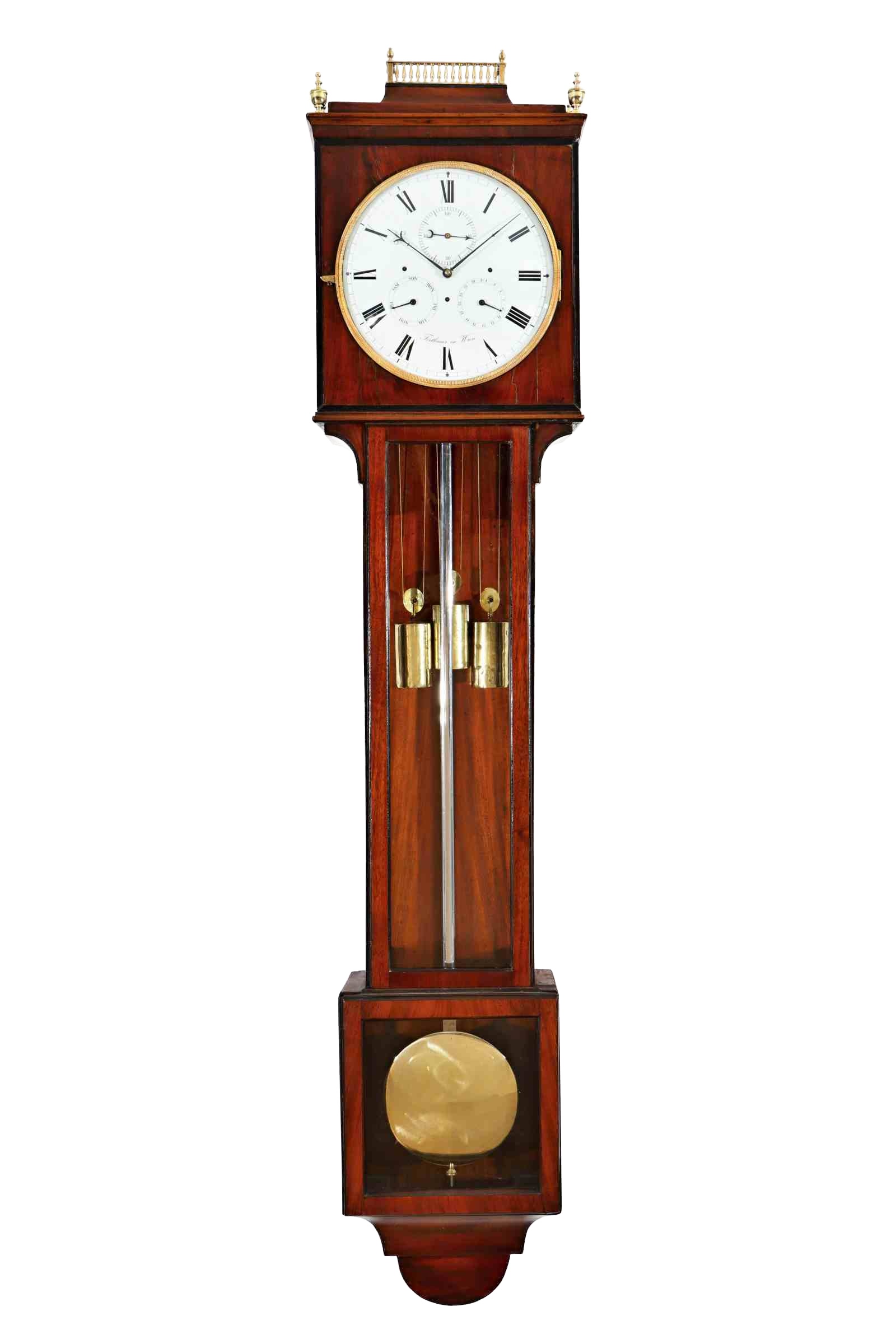
Vienna, circa 1805, enamel dial with subsidiary dials for days of the week, date and seconds, signature: „Fertbauer in Wien“, dial with convex glazed door, gilded engine turned bezel, hands of blued steel, glass enclosed movement, duration: 8 days, grande sonnerie on two bells, has Fertbauer’s own deadbeat escapement, strike silent lever, steel rod pendulum, mahogany veneered case with ebonised stringing, total dimensions 150 x 31,5 x 13 cm.
Literature: These clocks are published in the book DIE WAND - & BODENSTANDUHREN DER DONAUMONARCHIE. UHRMACHERZENTREN 1780-1850, Stephan Andréewitch a Paul Archard, page 378.
Philipp Franz Fertbauer (1763–1820) ranks among the most important Viennese clockmakers of the late 18th and early 19th centuries. As a guild master and a respected innovator in the field of clock movements, he created works of exceptional technical and aesthetic quality. His Laterndluhr are distinguished by their precise craftsmanship, advanced technical design, and characteristic constructional solutions, including his own escapement. Fertbauer’s Laterndluhr are regarded as the pinnacle of Viennese clockmaking of their time and are among the rarest and most valuable examples of this type.